Monday, May 20, 2013

Susan Jocelyn Bell Burnell Biography

    Susan Jocelyn Bell Burnell, born on July 15th, 1943 in Belfast, Ireland is a well known astronomer who has contributed greatly to the field.  Her interest in astronomy was peaked by her father who worked as an architect for the Armagh Observatory.  She studied physics in college at the University of Glasgow and later attained her Ph.D. From Cambridge.  With professor Antony Hewish she successfully made a 81.5 megaherz radio telescope at Cambridge.  Using this resource, she studied interplanetary scintillation of compact radio sources.  This basically means she was studying what would later become known as pulsars.  She discovered the first pulsar during these years while searching for quasars.  The first four pulsars ever discovered were all found by Bell Burnell  A pulsar is a radio star which is emitting flashes of electromagnetic radiation in a pattern associated with its rotation.  A lighthouse is a commonly used example of pulsar like behavior.  Burnell's discovery of the first pulsar came after analyzing a 400 foot long paper chart created from observations using her telescope.  This discovery took place in 1967 and she published her findings in an appendix on her thesis.
    After her discovery, controversy arose when Bell Burnell was not awarded the Nobel Prize for her work.  Instead, the prize was given to Sir Martin Ryle and Tony Hewish.  The discovery of the pulsar was attributed to Hewish although Bell Burnell was known to have actually made this breakthrough. 
    After her discovery, Bell Burnell studied and taught as a teacher's assistant at the University of Southampton.  She was mostly focused on studying electron density.  During her time at Southampton she developed a 1-10 million electron volts gamma-ray telescope.
    After her time at Southampton, Bell Burnell continued to research and work as a programmer at various laboratories in England.  Some of her most notable work includes studying the x-ray emission coming from galactic features.  She used the information she gained to observe various types of galactic objects including star systems and galaxies.  She also held many teaching positions throughout her career and was the editor for The ObservatoryThe Observatory is a renowned journal focusing on astronomy. 
    Bell Burnell's discovery of pulsars has been instrumental in the field of astronomy.  Pulsars have been used to confirm that gravitational radiation exists and also later led to the discovery of the first extrasolar planets.  Pulsars are usually extremely precise in terms of the periods between their pulses.  Therefore, pulsars are used to build pulsar clocks which have been found to be more accurate than atomic clocks.  Some pulsars are also used to find gravitational waves which are basically ripples in spacetime predicted by Albert Einstein's theory of general relativity.
    In addition to making a huge contribution to the field of astronomy, Bell Burnell provided many women scientists with hope that they too could become successful and be recognized for their work.  When she discovered pulsars, there were not many notable women scientists for young women hoping to pursue a career in the sciences to look up to.  Bell Burnell became this role model for many although she was not recognized with a Nobel Prize for her discovery which was instead given to a man working on the project with her.  Nonetheless, Bell Burnell has received numerous awards including the Michelson Medal from the Franklin Institute, the J Robert Oppenheimer Memorial Prize, the Beatrice M Tinsley Prize, and the Herschel Medal from the Royal Astronomical Society in London.  She has also been the president of the Royal Astronomical Society and the Institute of Physics.  Besides her work in the field of science, Bell Burnell has also worked to give more young girls the change to continue their education by being the house patron of Burnell House at Cambridge House Grammar School.
    Bell Burnell is now 69.  There was a documentary created about her entitled “Beautiful Minds” in which she spoke about the sexism present in scientific fields and her beliefs.  She is a Quaker and says that”Quakerism and research science fit together very, very well.” 


"Pulsars and Black Holes." Universe, Rev. ed. Robin Kerrod. New York: Dorling Kindersley, 2009. 52-53. DK Eyewitness Books. Gale Virtual Reference Library. Web. 8 May 2013.

Schafer, Elizabeth D. "Jocelyn Bell Burnell." Science and Its Times. Ed. Neil Schlager and Josh Lauer. Vol. 7: 1950 to Present. Detroit: Gale, 2001. 442-443. Gale Virtual Reference Library. Web. 8 May 2013.

Ruskin, Steve. "The Discovery of Pulsars." Science and Its Times. Ed. Neil Schlager and Josh Lauer. Vol. 7: 1950 to Present. Detroit: Gale, 2001. 393-396. Gale Virtual Reference Library. Web. 8 May 2013.

"Burnell, Jocelyn Bell (1943–)." Dictionary of Women Worldwide: 25,000 Women Through the Ages. Ed. Anne Commire and Deborah Klezmer. Vol. 1. Detroit: Yorkin Publications, 2007. 299. Gale Virtual Reference Library. Web. 8 May 2013.

"Susan Jocelyn Bell Burnell." Encyclopedia of World Biography. 2nd ed. Vol. 2. Detroit: Gale, 2004. 133-134.Gale Virtual Reference Library. Web. 8 May 2013.

Friday, May 17, 2013

Observations for the Week

These observations were made at various times between May 10th and 18th.  They total three hours.

During this time, the moon appeared to be in its waxing crescent phase.  Because of this, it did not create too much light as to interfere with my observations.  Early in the evening on the 10th, the moon was very low in the sky and was close to the planet Venus.

I used my knowledge of constellations to identify stars and the areas constellations would occupy if they were more clearly visible.  I saw Arctures, in the constellation Bootes, easily.  I found this by "following the arc to Arctures" from Ursa Major.  Orion was visible and using my phone I was able to discern which star was Beetlegeuse and Rigel.  Leo was also visible at times.  I found Capella, in the constellation Auriga as well.

I made these observations from my yard in Venice so there was some light pollution from the park near my house earlier in the evenings.

Zooniverse

This week, I spent 4 hours completing Zooniverse tasks.  I continued with the same activity of identifying "Clouds."

APOD 4.8

Kepler's Supernova Remnant in X-Rays

See Explanation.  Clicking on the picture will download
 the highest resolution version available.

    This nebula was created by a star explosion.  It is known as Kepler's Supernova and is located in the Milky Way in the constellation Ophiuchus.  This nebula, when it was formed, was visible to the naked eye and had a magnitude of 2.5.  Kepler first observed it in Italy in 1604.  Kepler did not use a telescope when he was discovering it.  Now, scientists use various telescopes like the X-Ray Observatory used to create this picture.  This was a white dwarf star which exploded after accumulating material from a Red Giant companion.  This supernova is about 13,000 light years away and is the most recent supernova to be observed in the Milky Way galaxy.  

Friday, May 10, 2013

APOD 4.7

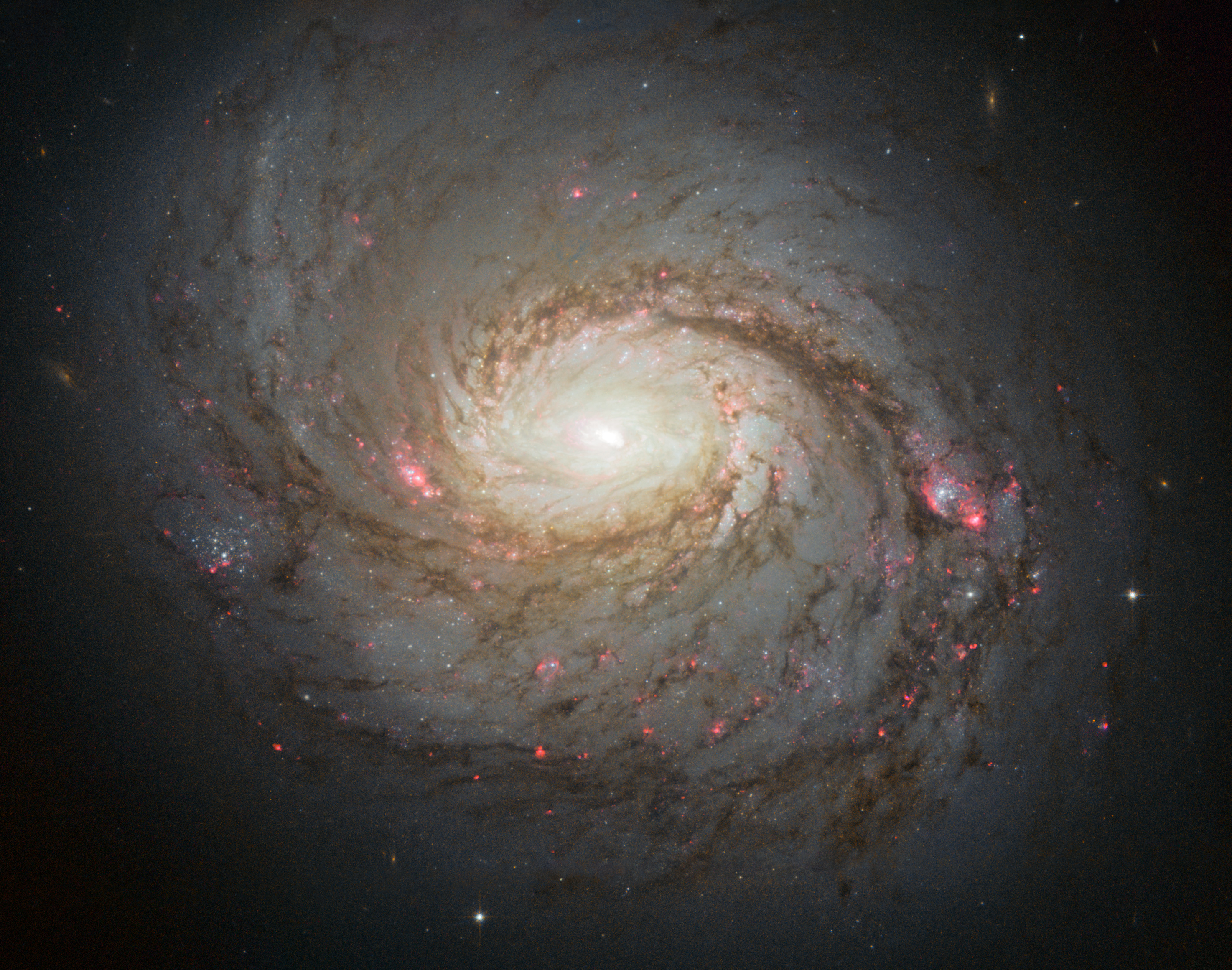
Messier 77 10 May 2013

See Explanation.  Clicking on the picture will download
 the highest resolution version available.

    Messier 77 is a Spiral Galaxy in the constellation Cetus.  Cetus is known as the sea monster.  This is an active galaxy and can be classified as a "Seyfert Galaxy."  This object was discovered in 1780 and was at first thought to be a nebula.  Charles Messier believed it to be a cluster.  This is one of the largest galaxies listed as a M object.  It is about 47 million light-years away and is 100 light-years across.  It has a very distinct and bright core which has been the object of observation and study of many scientists.  These scientists are interested in the core in particular because it is possible that it contains a black hole.  This image uses the visible light and is based on data from Hubble.  The red regions contain active star formation.

APOD 4.6

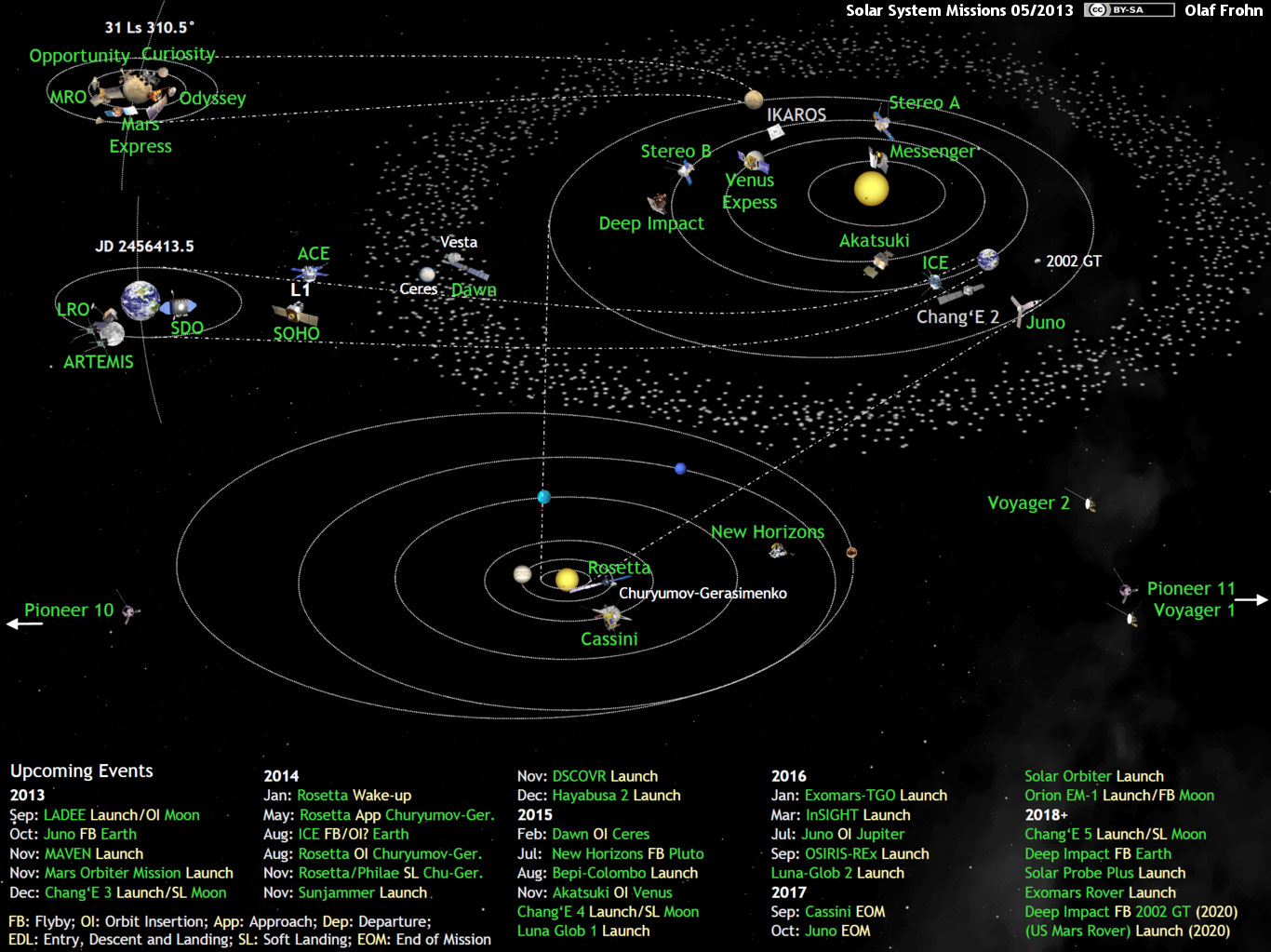
Humanity Explores the Solar System 30 April 2013

See Explanation.  Clicking on the picture will download
 the highest resolution version available.

    Many technological advances have come about in terms of astronomy in the past few decades.  Currently, there is an explorer around every inner planet in our solar system.  Also, we are monitering the Sun with robotic explorers.  Detailed maps of the Moon have been created with these types of satellites and asteroids and comets can even by explored with modern technology.  We also have spacecrafts going out into deep space, a feat few imagined would be possible in the past.  This image shows some of the areas which are currently being explored and also lists at the bottom projected advances which will be occuring up until 2018.

Friday, April 26, 2013

Zooniverse

This week, I classified clouds in the "Cloud" activity for a total of 4 hours in class.

APOD 4.5

April 24 2013 Wringing a Wet Towel in Orbit


    Aboard Expedition 35, CHris Hadfield performed an experiment to see what would happen if he attempted to wring out a towel in space.  Of course, there is no gravity aboard the space craft so the water does not simply fall to the floor as it would on Earth.  Rather, the high surface tension on the towel causes the water to coagulate on the surface and form a sort of bubble around both the towel and Hadfield's hands.  The gravity aboard the mission is not actually zero but is very small and is referred to as microgravity.  The phenomena which causes the water to stay on the surface of the towel is similar to that which creates raindrops on Earth.

APOD 4.4

April 22nd 2013 The Horsehead Nebula in Infrared from Hubble

See Explanation.  Clicking on the picture will download
 the highest resolution version available.

    Stellar winds in space have coagulated dust into a cloud recognizable as a horse's head.  The Horsehead Nebula is located in the constellation Orion and contains M42, the Orion Nebula, within in.  The Horsehead Nebula is a dark emission nebula and was discovered in 1888 by Williamina Fleming at Harvard University.  It is about 1500 light years away from us and the pink visible in the nebula is the result of hydrogen gas from the close-by star Sigma Orionis.  This image uses the infrared and was taken by the Hubble Space Telescope.  In the far future, this nebula will be destroyed by the starlight which contains high amounts of energy.
    

Wednesday, April 17, 2013

Observation from Astronomy Night

    At Astronomy Night on March 30th, we observed many constellations in addition to satellites and M objects.  The easiest constellation to identify was Orion which was clearly visible even early in the evening. We also looked at Ursa Major, Gemini, Taurus, Canis Major and Minor, and Leo among others.

    During the night, we saw the International Space Station pass overhead.  I was able to locate it through binoculars and watch its movement as well as with the naked eye.  It appeared as a bright point moving across the sky.
    I helped to operate one of the large telescopes and pointed it at M 36, M 37, and M 38 in the constellation Auriga. All three of these appear to be open clusters.  We also attempted to view the Pleiades through the telescope but were not able to in its entirety because of the magnification of the telescope.
    We located the planet Jupiter and were able to see surface features through each telescope.

    Luckily, it was a pretty clear night in terms of clouds but there was a lot of light pollution from Sarasota and some constellations were hard to see because of the lack of darkness in that area of the sky.

These observations total 4 hours.

Friday, April 12, 2013

APOD 4.3

NGC 3132: The Southern Ring Nebula

See Explanation.  Clicking on the picture will download
 the highest resolution version available.

NGC 3132 is a planetary nebula also called the Eight-Burst Nebula.  It is located in the constellation Vela.  It is about 2,000 light-years away.  The gas pictured originated in a star similar to the sun.  This nebula is intriguing to astronomers because it is asymmetrical.  The differences in structure which are clearly visible are not understood by scientists.  It has dust lanes which are cool filaments.  This is part of a binary system and the gas is remnants from the outer layer of a star.   
    

Friday, April 5, 2013

APOD 4.2

Flying Over Earth at Night: March 31 2013

    This APOD posting is a video taken using the International Space Station (ISS).  Music credit goes to the Freedom Fighters, whose song "Two Steps from Hell" is featured in the video.  Clouds, land masses, and oceans can clearly be seen, dotted with city lights and frequent lightning flashes.  It is interesting to note that the W coast of Florida is particularly bright compared to other areas with the highest concentration of light pollution seen from the Tampa and Sarasota area.  The atmosphere is seen as a "golden haze" along the top of the Earth.  Also, green and red auroras can be seen throughout the film.  The ending of the video features the increasing sunlight at dawn.

Thursday, March 28, 2013

APOD 4.1


See Explanation.  Clicking on the picture will download 
the highest resolution version available.

A Horizon Rainbow in Paris

    Although the rainbow which appears above Paris in this image looks rather unusual, it is actually just as ordinary rainbow.  The Sun is very high in the sky at the time of this photo, causing it to appear horizontal to the ground.  According to the physics laws governing the creation of rainbows, the center of a rainbow must be exactly opposite the sun.  A rainbow is created by the light reflecting off of water drops in the atmosphere.  "Primary Rainbows show red towards the outside and violet on the inside towards the ground.  Secondary rainbows appear just the opposite.  This image depicts a primary rainbow.  The reason this rainbow appears flat is that only the upper portion of the arc is visible.  The usual "sides" of the rainbow are below the horizon in this case.  This feature was only visible from a certain angle and lasted a few minutes.

Saturday, March 23, 2013

Observation 4


Ep. 267: Infinities

Ep. 267 Infinities

   The concept of infinity and zero are both relatively new concepts.  Infinity began to be discussed around 400 BC.  Zeno developed the concept of potential infinities and finite infinities.  Enumerable things are able to be counted and innumerable things are uncountable but are still limited.  Some examples would be the number of grains of sand on the beach.  Other things are not finite such as the expansiveness of a mathematical plane.  Another concept then developed of different quantities making up infinities.  The set of numbers is infinite as is the set of even numbers but the set of even numbers is less than the set of integers.  Countable infinities include all sets of integers.  Uncountable infinities include the list of all real numbers, including the numbers between each integer.  
    The infinity sign has debatable origins but most likely it was developed in 1655 by John Willis, a mathematician.  Some say it is based on Omega from the Greek alphabet which is the last letter.  The infinitesimal accompanies the concept of infinity and, like infinities, has different types.  
    The hotel or Hilbert's paradox states that a hotel with a finite number of guests, an infinity of new guests come in.  A countable infinity comes in as you add rooms and guests.  
    Applied to astronomy, an issue comes up when thinking about infinities and space.  If the universe in infinite in size and age, then whatever direction we look we should see a star.  This obviously does not occur in nature implying that the universe is either finite in age, size, or both.  The universe is most likely 13.7 billion years.  A multiverse is a theory that there are many universes similar to ours. 

Observation 3

Ep. 269 Mass
Ep. 269: Mass        Mass and energy can be connected through the equation e=mc^2.  Mass is defined as the property which causes acceleration to be less effective when force is applied.  (F=M(acceleration)).  Acceleration is a change in speed, direction, or both simultaneously.  In contrast, weight is the force something exerts on something else it is resting on.  Weight is actually measured in Newtons because kilograms represent mass and not weight.  Mass does not change depending on which planet something is on, but weight does.  The masses of planets and the Sun can be calculated using equations involving the orbiting planets or moons.  This measures the gravitational force between two objects, eventually giving you the mass of the object in question.  
    Einstein's famous equation not only connects mass and energy but also explains why stars do not burn out quickly.  If enough energy is present, like in particle accelerators, the kinetic energy is released and condenses into particles.  Some theories say that the universe could eventually end due to proton decay.  This would cause energy to spread out and eventually not be able to condense into particles.  
    Higgs-Bosons are present near every atom.  Atoms are made up of many particles with mass and Higgs-Bosons "fly around" and adhere you to the scaler field which is ever present in the universe.  The graviton is an example of a boson particle although it is not detectable because it has no mass.  

Friday, March 22, 2013

Observation 2: Astronomy Cast


Ep. 285  How the World Will Really End

Ep. 285 How the World Will Really End

    The most current theory of how the world will end is regarding a rogue planet which is said to be coming near the Earth which will change the magnetic fields of the Earth and have catastrophic effects.  This theory is "backed up" by a painting by the Mayans which contains an extra planet.  This is called the "rogue planet theory."  The flaws in this theory include the fact that if an object the size of Earth were somewhere close enough in space to be approaching Earth in the near future, it would be able to be seen with binoculars or even the naked eye.  It also would have most likely moved the moon if it were coming very soon and was in close proximity to the Earth.  
    Another theory regards the sun and says that the Sun will become very highly active and will "roast" the Earth.  The Sun has been observed in the past to have gone through periods of various activity levels and, obviously, the Earth has not been destroyed.  Solar flares could change the magnetic field and knock out power.  Also, some solar flares have "killed" satellites, disrupting telecommunications.  The only thing which is likely to be affected on Earth is electricity.  
    Planets are rumored to be "lining up" in the near future over the pyramids.  The power of gravity is believed by some to be able to affect the Earth.  In 1999, this lining up did occur but the gravitational pull is not nearly strong enough to affect anything on Earth.  
    During December, the Sun is "lined up" with the center of the galaxy as it is in the constellation Sagittarius.  This does not have large gravitational effects as some claim it would.  Another common worry is about tiny black holes which could be formed and "eat" the Earth.  This will not occur in a short amount of time because even if a tiny black hole was at the center of the Earth, it would not destroy the planet in a reasonable amount of time (other methods will most likely destroy the world first).
    The most likely way the Earth would end is a comet collision.  Again, this would be seen in advance and many people would know about it before it occurred.

Observation 1: Astronomy Cast


Ep. 281 Explosions in Space

Ep. 281 Explosions in Space

    A common mistake in science fiction is how films display explosions which occur in space.  In reality, explosions in space would not be extremely loud and dramatic as they are often portrayed.  
    Explosions require both a fuel and an oxidizer to occur.  In space, there is no oxygen so anything which explodes would have to have its own oxidizer present.  There is also no pressure which would moderate an explosion, drawing it out in length.  An explosion in space would last an extremely short amount of time and would expand outward in a perfectly spherical manner, assuming the explosive device is round.  Explosives such as bullets and dynamite do have their own oxidizers contained in them, so the explosion could occur in space.  In early space travel, it was discovered that if there is too much oxygen combined with the burning fuel in a spacecraft, the spacecraft will explode and be destroyed.  
    Sound from explosions is not heard as it would be on Earth.  The energy reaching you will go down by a factor of 4 in space each time you double your distance from the exploding object, according to the "one over R squared" law.  This is because the shock wave expands in a circular manner in all directions.  Even if you were very close to an explosion in space, you would hear minimal noise.  Energy very quickly dissipates because there is no atmosphere to take in the energy.  A nuclear reaction in space would not be seen because it would become literally a flash of energy.  There is no atmosphere to show the fluorescence of it.  
    Natural explosions in space are much more visible than synthetic ones would be.  Many reactions will occur consecutively.  Expanding gas can show more of a "flame thrower" effect.  Coronal mass ejections are energy releases and are, on our sun, basically magnetic loops.  These can be seen and have been photographed and recorded.  Supernovas are another example of a natural explosion in space.  They are collapsing stars in which atoms are compressed until they break apart.  These explosions are very violent.    

Friday, March 8, 2013

APOD 3.8

The Heart Nebula March 4 2013

See Explanation.  Clicking on the picture will download 
the highest resolution version available.

    This emission nebula IC 1805, also called the heart nebula is in the Perseus Arm of the Galaxy.  It requires a telescope for viewing and is also called the Running Dog nebula.  It is composed of glowing interstellar gas and dark dust clouds.  It is 7,500 light years away and this image shows that it is 200 light years across.  Near the center of the nebula is the star cluster called Melotte 15 which is very young at only 1.5 million years of age.  It is is the constellation Cassiopeia and this image has the span of about four times the diameter of the moon.  I found this image interesting because we have been studying the formation of stars and this nebula is the perfect example of a young star cluster forming from the matter in the nebula.

Thursday, March 7, 2013

Maria Mitchell Biography

Maria Mitchell was born to William Mitchell and Lydia Coleman on August 1st, 1818. She was the third of ten children born to her parents and her family was a part of the Society of Friends, or Quakers, who had moved from England to America. Her parents both had strong passions for learning as her mother had worked in a library for two years for the sole purpose of reading all the books it contained. Her father provided for the family by rating chronometers of ships' captains. A chronometer is a very precise clock which was used by captains to determine their exact longitude. They used this information to navigate by means of the stars. On the side, her father was an amateur astronomer who inspired Maria's love for the heavens. As a child, she helped her father with his work and through this process, learned about both mathematics and astronomy.


            Her Quaker family believed that equal importance should be given to the education for both boys and girls. They lived in an area which was full of natural phenomena which helped to inspire Maria's love for nature and science. She went to a private elementary school and then later to a school which her father ran. His school focused mostly on observations of nature. She then attended the Cyrus Peirce's school for young ladies where the headmaster saw her unique abilities in math and science and encouraged her to pursue her education with a passion. She was described as being “born of only ordinary capacity, but of extraordinary persistency.” She also worked as a librarian for twenty years and continued her own study while employed. She was fluent in French and studied science textbooks in that language. Because of her passion for education, she started her own school in 1835. She was an unconventional instructor who began school before sunrise for the purpose of watching birds with students in the morning and also stayed late into the night to view the stars. Throughout her life, she earned an honorary degree from Hanover College in 1853, Columbia University in 1887, and an honorary doctorate from Rutgers Female College a few years later.
Because she had been so passionate about education and in particular astronomy, Maria was frequently seen making observations at night. During her childhood, she was a helper to her father and together they made thousands of observations which were used for the U.S. Coast Survey. During her life, she also was a computer for the American Ephemeris and Nautical Almanac, working there for 19 years. All of the observations were regarding accurate time and latitude. In 1847, she discovered a new comet which was named after her and brought her worldwide fame. She first viewed it while at her father's observatory, using only a two inch telescope. The King of Denmark gave her a gold medal for her discovery and after that, she became a well known astronomer in both the United States and Europe. She is considered to be the first well known woman astronomer. In 1848 she was the first woman to be elected into the American Academy of Arts and Sciences, her membership being proposed by the very well known geologist Louis Agassiz. She joined the American Association for the Advancement of Science in 1850. In 1857, Maria became the chaperone for the daughter of a prominent Chicago business man and traveled with her to Europe. She visited many observatories during her trip and even met one of her idols, the astronomer Mary Somerville. Soon after, Maria was asked to be a professor of astronomy and the director of the observatory for Vassar College. She encouraged small classes made up of conversation rather than lecturing. Because she felt such a passion for granting other women the opportunities she was given as a child in terms of education, she decided at this point in her life to devote her Maria Mitchell was born to William Mitchell and Lydia Coleman on August 1st, 1818. She was the third of ten children born to her parents and her family was a part of the Society of Friends, or Quakers, who had moved from England to America. Her parents both had strong passions for learning as her mother had worked in a library for two years for the sole purpose of reading all the books it contained. Her father provided for the family by rating chronometers of ships' captains. A chronometer is a very precise clock which was used by captains to determine their exact longitude. They used this information to navigate by means of the stars. On the side, her father was an amateur astronomer who inspired Maria's love for the heavens. As a child, she helped her father with his work and through this process, learned about both mathematics and astronomy.
Her Quaker family believed that equal importance should be given to the education for both boys and girls. They lived in an area which was full of natural phenomena which helped to inspire Maria's love for nature and science. She went to a private elementary school and then later to a school which her father ran. His school focused mostly on observations of nature. She then attended the Cyrus Peirce's school for young ladies where the headmaster saw her unique abilities in math and science and encouraged her to pursue her education with a passion. She was described as being “born of only ordinary capacity, but of extraordinary persistency.” She also worked as a librarian for twenty years and continued her own study while employed. She was fluent in French and studied science textbooks in that language. Because of her passion for education, she started her own school in 1835. She was an unconventional instructor who began school before sunrise for the purpose of watching birds with students in the morning and also stayed late into the night to view the stars. Throughout her life, she earned an honorary degree from Hanover College in 1853, Columbia University in 1887, and an honorary doctorate from Rutgers Female College a few years later.
Because she had been so passionate about education and in particular astronomy, Maria was frequently seen making observations at night. During her childhood, she was a helper to her father and together they made thousands of observations which were used for the U.S. Coast Survey. During her life, she also was a computer for the American Ephemeris and Nautical Almanac, working there for 19 years. All of the observations were regarding accurate time and latitude. In 1847, she discovered a new comet which was named after her and brought her worldwide fame. She first viewed it while at her father's observatory, using only a two inch telescope. The King of Denmark gave her a gold medal for her discovery and after that, she became a well known astronomer in both the United States and Europe. She is considered to be the first well known woman astronomer. In 1848 she was the first woman to be elected into the American Academy of Arts and Sciences, her membership being proposed by the very well known geologist Louis Agassiz. She joined the American Association for the Advancement of Science in 1850. In 1857, Maria became the chaperone for the daughter of a prominent Chicago business man and traveled with her to Europe. She visited many observatories during her trip and even met one of her idols, the astronomer Mary Somerville. Soon after, Maria was asked to be a professor of astronomy and the director of the observatory for Vassar College. She encouraged small classes made up of conversation rather than lecturing. Because she felt such a passion for granting other women the opportunities she was given as a child in terms of education, she decided at this point in her life to devote her work to education rather than practical astronomy. In 1873, she founded the Association for the Advancement of Women and served as president. After her work with this agency advocating for the recognition of women's contributions to science, she was the first woman elected to the American Philosophical Society in 1873. Regarding her job as either a teacher or observer, Maria said, “the scientist should be free to pursue his investigations. He cannot be a scientist and a schoolmaster... It is not all mathematics, nor all logic but is somewhat beauty and poetry.” After her death, Maria had a crater named after her on the moon. Also, the Maria Mitchell Association of Nantucket was formed in her honor, maintaining the Maria Mitchell Observatory. There are now several institutions named after her such as the Boston Public Library and a public school located in Denver, Colorado.work to education rather than practical astronomy. In 1873, she founded the Association for the Advancement of Women and served as president. After her work with this agency advocating for the recognition of women's contributions to science, she was the first woman elected to the American Philosophical Society in 1873. Regarding her job as either a teacher or observer, Maria said, “the scientist should be free to pursue his investigations. He cannot be a scientist and a schoolmaster... It is not all mathematics, nor all logic but is somewhat beauty and poetry.” After her death, Maria had a crater named after her on the moon. Also, the Maria Mitchell Association of Nantucket was formed in her honor, maintaining the Maria Mitchell Observatory. There are now several institutions named after her such as the Boston Public Library and a public school located in Denver, Colorado.   
Sources:

Ragan, Gay A. "Mitchell, Maria." Mathematics. Ed. Barry Max Brandenberger, Jr. Vol. 3. New York:                
Macmillan Reference USA, 2002. 51. Gale Virtual Reference Library. Web. 7 Mar. 2013.

DEROCHE, CELESTE. "Mitchell, Maria." American Women Writers: A Critical Reference Guide from Colonial Times to the PresentA Critical Reference Guide from Colonial Times to the Present. Ed. Taryn Benbow-Pfalzgraf. 2nd ed. Vol. 3. Detroit: St. James Press, 2000. 151-152. Gale Virtual Reference Library. Web. 7 Mar. 2013.

"Maria Mitchell." Encyclopedia of World Biography. 2nd ed. Vol. 11. Detroit: Gale, 2004. 61. Gale Virtual Reference Library. Web. 7 Mar. 2013.

"Mitchell, Maria." Complete Dictionary of Scientific Biography. Vol. 9. Detroit: Charles Scribner's Sons, 2008. 421-422. Gale Virtual Reference Library. Web. 7 Mar. 2013.

Friday, March 1, 2013

APOD 3.7

March 1 2013 Colors of Mercury

See Explanation.  Clicking on the picture will download 
the highest resolution version available.

    This picture shows Mercury, our solar system's innermost planet.  Mercury has an orbital period of 88 days and can reach 800 degrees Fahrenheit on its surface.  This image was taken using the MESSENGER (MErcury Surface Space ENvironment, GEochemistry, and Ranging) spacecraft which is orbiting Mercury. This photo is enhanced to show color because the human eye would not be able to discern the colorful features visible here.  The colors are real though and reflect the chemicals and minerals present on the surface.   The Caloris basin can be seen in the upper right hand corner.  It was created by an asteroid which struck the planet in the early days of the solar system.  After the impact, lava entered the basin and created the feature which can now be seen.